



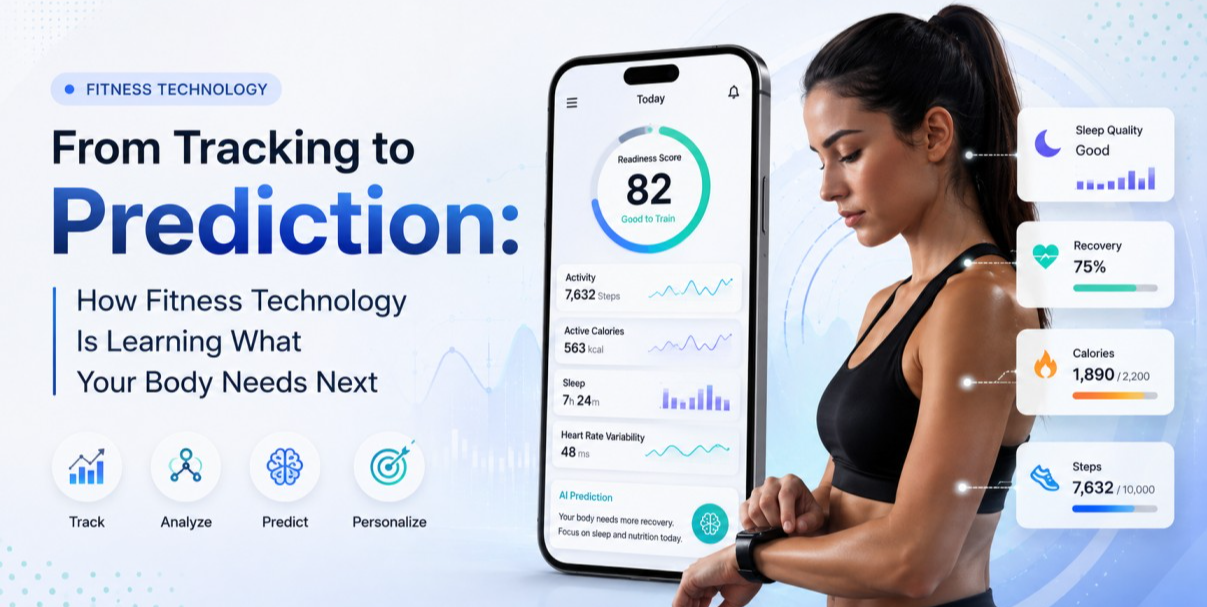
From Tracking to Prediction: How Fitness Technology Is Learning What Your Body Needs Next
Fitness technology has spent the last decade answering a simple question: What did I do today? How many steps did I take? How many calories did I burn? How long did I sleep? How fast did I run?
That model is now changing.
Modern fitness technology is increasingly focused on a more useful question: What should I do next? Instead of simply recording activity, connected fitness platforms are beginning to interpret patterns across exercise, nutrition, sleep, recovery and daily activity to provide more personalized recommendations.
This shift from tracking to prediction could fundamentally change how people interact with fitness applications.
From Data Collection to Actionable Insights
Traditional fitness apps collect large amounts of information. A user may record meals, workouts, body weight, steps and water intake, while a smartwatch continuously measures heart rate, sleep and physical activity.
The challenge is not collecting data anymore. It is understanding what that data means.
For example, completing a hard workout after several nights of poor sleep may produce a very different outcome from completing the same workout after adequate recovery. A modern fitness platform can potentially combine these signals and recommend a lighter training session, additional recovery or a change in nutritional intake.
This makes fitness technology more contextual. Instead of presenting isolated numbers, it can help users understand relationships between different aspects of their lifestyle.
Why Recovery Is Becoming a Major Part of Fitness Technology
Fitness has traditionally focused heavily on performance: more repetitions, longer distances, higher intensity and more calories burned.
Recovery is now becoming equally important.
Wearables can collect indicators such as resting heart rate, heart-rate variability, sleep duration and activity levels. When analyzed over time, these signals can help create a broader picture of readiness and fatigue.
A fitness application may use this information to adjust workout recommendations. Someone showing signs of reduced recovery could receive a lower-intensity workout, while a user demonstrating consistent recovery may be presented with a more demanding training plan.
The goal is not to predict the future perfectly. It is to make recommendations more responsive to the user's current circumstances.
Nutrition Data Is Becoming Part of the Prediction
Exercise does not exist independently from nutrition. This is where food and calorie tracking technology can become particularly valuable.
Modern calorie tracking app development services can incorporate features such as food databases, meal logging, nutrition analysis, activity synchronization and personalized calorie targets. When combined with exercise and wearable data, these features can provide a more complete picture of energy intake and expenditure.
For example, an application could compare a user's recent activity level with their nutritional intake and historical patterns. Instead of simply showing that the user consumed a certain number of calories, the platform can provide context around how nutrition relates to their activity goals.
Future systems may become even more adaptive, adjusting recommendations based on workout intensity, recovery, daily movement and longer-term progress.
The Role of Connected Wearables
The growth of smartwatches, fitness bands, smart rings and other connected devices is making continuous data collection easier.
These devices can capture information throughout the day without requiring users to manually enter everything. That creates an important opportunity for fitness applications.
A connected platform can combine wearable information with manually entered data and application-generated insights. For example, workout history can be analyzed alongside sleep and recovery trends to identify patterns that would be difficult for users to notice themselves.
For developers, this also means fitness applications are becoming more complex ecosystems rather than standalone mobile apps. Data synchronization, APIs, cloud infrastructure, privacy controls and real-time processing all become important parts of the product architecture.
Personalization Will Define the Next Generation of Fitness Apps
Not every user responds to the same workout, diet or recovery strategy.
A beginner may need simple guidance, while an experienced athlete may want detailed performance metrics. Someone focused on weight management may prioritize nutrition, while another user may be more interested in strength, endurance or general wellness.
This is why personalization is becoming central to fitness application design.
A modern fitness application development company can build systems that adapt interfaces, recommendations and goals according to individual user behavior. Machine learning can identify patterns within historical data, while rules-based systems can provide immediate recommendations based on predefined thresholds.
The most effective platforms will likely combine both approaches rather than relying on a single technology.
Prediction Does Not Mean Perfect Prediction
There is an important distinction between prediction and certainty.
Fitness technology cannot know exactly how a person will feel tomorrow or guarantee that a particular workout will produce a specific result. Health and fitness outcomes depend on numerous variables, including stress, lifestyle, genetics, environment and individual behavior.
Therefore, predictive fitness should be viewed as decision support rather than a replacement for professional judgment.
The quality of recommendations also depends heavily on data quality. Inaccurate food logging, missing wearable data or inconsistent measurements can affect the insights produced by an application.
Privacy is another critical consideration. Fitness platforms may handle sensitive personal and health-related information, making secure storage, transparent data practices and appropriate user controls essential.
Where Fitness Technology Goes Next
The next stage of fitness technology is unlikely to be defined simply by collecting more data. The real opportunity lies in making existing data more meaningful.
A successful fitness platform may eventually work more like a personal decision-support system: understanding recent activity, recognizing changes in recovery, considering nutrition and suggesting what action could make sense next.
This represents a fundamental change in the role of fitness applications. Instead of asking users to constantly interpret dashboards and numbers, technology can increasingly organize those signals into practical recommendations.
The journey from tracking to prediction is still developing, but the direction is clear. Fitness technology is moving from recording what happened toward understanding what might be needed next. For developers and businesses entering this space, the opportunity is not simply to build another tracking application. It is to create technology that turns complex fitness data into useful, personalized experiences.