



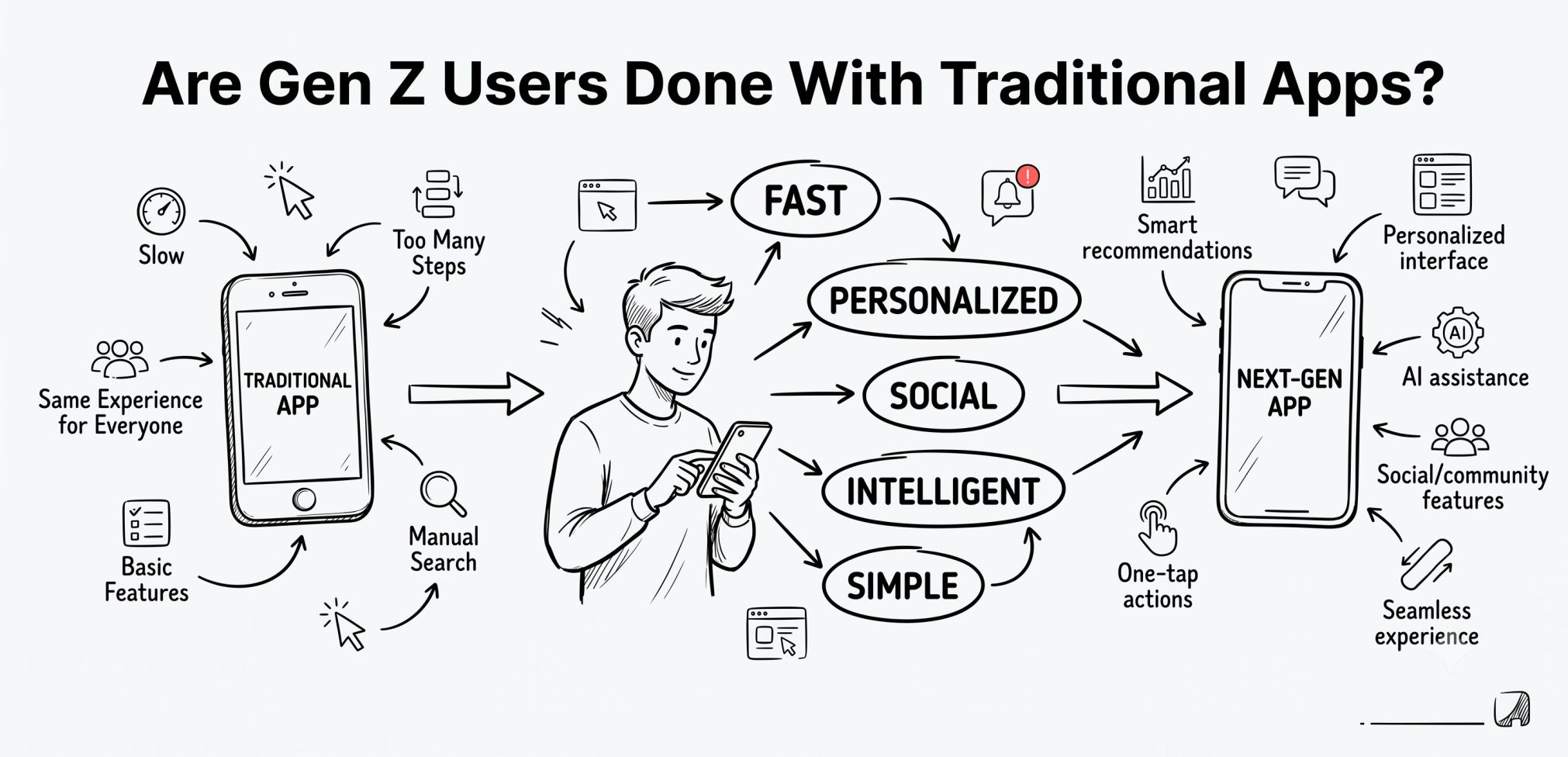
Are Gen Z Users Done With Traditional Apps?
For years, mobile apps followed a familiar formula: download the app, create an account, browse through menus, search for what you need, and complete an action.
That model is starting to feel outdated.
Gen Z has grown up with smartphones, social platforms, instant messaging, short-form content, and increasingly capable AI tools. For them, digital experiences are expected to be fast, personalized, interactive, and intelligent — not simply functional.
This doesn't mean Gen Z is abandoning apps. Instead, their expectations are changing. They want apps that understand their needs, reduce unnecessary steps, and deliver value almost instantly.
For businesses, this shift means that working with the right app development company is no longer just about building an app that works. It's about creating a digital experience that users actually want to keep using.
1. Speed Is No Longer a Feature. It's an Expectation
Gen Z has very little patience for slow-loading screens, unnecessary steps, or confusing interfaces.
If an app takes too long to open, makes users complete five steps for something that could take two, or constantly crashes, there are usually plenty of alternatives available.
Performance has therefore become one of the most important parts of the user experience.
A modern app should:
- Load quickly
- Respond immediately to user actions
- Keep navigation simple
- Minimize unnecessary screens
- Work reliably across devices
- Make important actions easy to find
For Gen Z, friction is a reason to leave.
2. Personalization Is Becoming the New Default
Traditional apps generally gave everyone the same experience.
The same homepage.
The same menus.
The same recommendations.
Modern users increasingly expect something different.
They want apps to understand their preferences and adapt to them.
Think about how recommendation systems work on social media, streaming services, and shopping platforms. Instead of asking users to manually search for everything, the app continuously learns what might be relevant.
This expectation is now spreading beyond entertainment.
Users increasingly want their digital experiences to feel relevant to their interests, behavior, location, goals, and preferences.
The broader shift is clear:
Users don't just want an app. They want an experience designed around them.
3. Gen Z Wants Apps to Be More Intelligent
AI is changing what users expect from software.
AI is no longer something people encounter only in specialized tools. It is becoming part of everyday digital experiences, from search and content creation to shopping, education, productivity, and entertainment.
This is particularly relevant for Gen Z, which is comfortable experimenting with AI tools in everyday life.
The experience is gradually moving from:
Search → Find → Select → Action
toward:
Tell the app what you need → Let the app help.
For example, imagine a fitness app where users don't have to manually create a workout plan.
They could simply say:
"I have 30 minutes today and want to focus on upper body."
The app could understand the request, recommend a workout, adjust it based on previous activity, and track progress.
That's a fundamentally different experience from a traditional app.
4. Social Features Are Becoming Part of the Experience
Gen Z doesn't necessarily separate "social apps" from other types of apps as clearly as previous generations did.
Social interaction is increasingly becoming part of shopping, education, fitness, entertainment, and discovery.
Consider a fitness application.
Instead of being just a place to record workouts, it could include:
- Community challenges
- Progress sharing
- User-generated content
- Comments and reactions
- Friend activity
- Leaderboards
- Direct messaging
The same principle can work across different industries.
An education app could include peer communities. A shopping app could include user reviews and social recommendations. A travel app could allow users to share experiences and itineraries.
The app becomes more than a tool.
It becomes a digital environment.
5. Gen Z Wants Convenience, Not More Features
There's an important distinction here.
Building more features doesn't automatically make an app better.
In fact, too many features can make an app feel complicated.
What Gen Z increasingly expects is useful technology with less effort.
That could mean:
- One-tap payments
- Smart recommendations
- Automated reminders
- Voice interaction
- Personalized dashboards
- AI-assisted search
- Predictive suggestions
- Seamless third-party integrations
The goal isn't to put everything inside one application.
The goal is to make the important things easier.
For businesses investing in mobile app development services, this is an important consideration. The focus should be on creating smoother user journeys rather than simply increasing the number of features.
The winning question for developers isn't:
"How many features can we add?"
It's:
"How many steps can we remove?"
6. Gen Z Doesn't Automatically Trust AI
There's an interesting contradiction.
Gen Z is comfortable experimenting with AI, but that doesn't mean they blindly trust it.
Users still want transparency when technology makes decisions for them.
For example, if an app provides an AI-generated recommendation, users may want to know:
- Why was this recommended?
- What information was used?
- How is their data stored?
- Can they change their preferences?
- Can they control the AI features?
This creates a major responsibility for developers.
Adding an AI chatbot to an app isn't enough.
The technology needs to be useful, transparent, and appropriately designed around the user's needs.
The future isn't simply "more AI."
It's better, more useful, and more trustworthy AI.
7. The Future App May Feel Less Like an App
This could be one of the biggest changes in digital product development.
Traditional apps require users to understand the interface.
They need to know where to tap, where to search, and where to find a particular feature.
The next generation of apps may increasingly understand intent instead.
Rather than navigating through multiple menus, users could describe what they want and let the software determine the next steps.
That means the future could look less like:
"Open the app and find the feature."
And more like:
"Tell the app what you want, and let it figure out how to help."
This shift is already influencing how businesses approach custom app development.
What This Means for App Developers
Gen Z isn't asking developers to make every app flashy or fill every screen with AI.
They're asking for something simpler:
Make technology feel effortless.
For businesses building apps in 2026, that means focusing on:
Performance
Fast and reliable experiences that don't make users wait.
Personalization
Interfaces and recommendations that adapt to individual users.
Intelligence
AI where it genuinely improves the experience instead of being added simply because it's trending.
Social Interaction
Community and sharing features where they add genuine value.
Simplicity
Fewer unnecessary steps and cleaner user journeys.
Trust
Clear data practices, privacy, and transparency.
The strongest apps won't necessarily be the ones with the longest feature lists.
They'll be the ones that understand what users actually need.
The Real Question Isn't Whether Gen Z Is Done With Apps
Gen Z isn't done with apps.
They're using digital products more than ever.
What's changing is their definition of a good app.
An app that simply stores information and provides basic functionality may no longer be enough. Users increasingly expect software to be responsive, personalized, connected, and capable of helping them accomplish things faster.
And this shift won't stop with Gen Z.
As younger users influence product design and digital culture, these expectations are likely to spread across generations.
The next generation of successful apps won't just ask users:
"What would you like to click?"
They'll understand:
"What are you trying to accomplish?"
That is the real transition from traditional apps to intelligent digital experiences.
For businesses planning their next digital product, the opportunity is clear: build technology around how people actually want to use it, not simply around what technology can do.
The future of apps isn't about adding more.
It's about making every interaction smarter, faster, and more meaningful.